SWE-ZERO-12M-trajectories is the largest open agentic-coding trace dataset as of May 14, 2026: 112 B tokens across 12.3 M trajectories, generated against 122 K real GitHub PRs from 3 K repositories in 16 programming languages. It is 5.7× larger than the previous biggest open agentic dataset and a 10× scale-up from the original SWE-ZERO release.
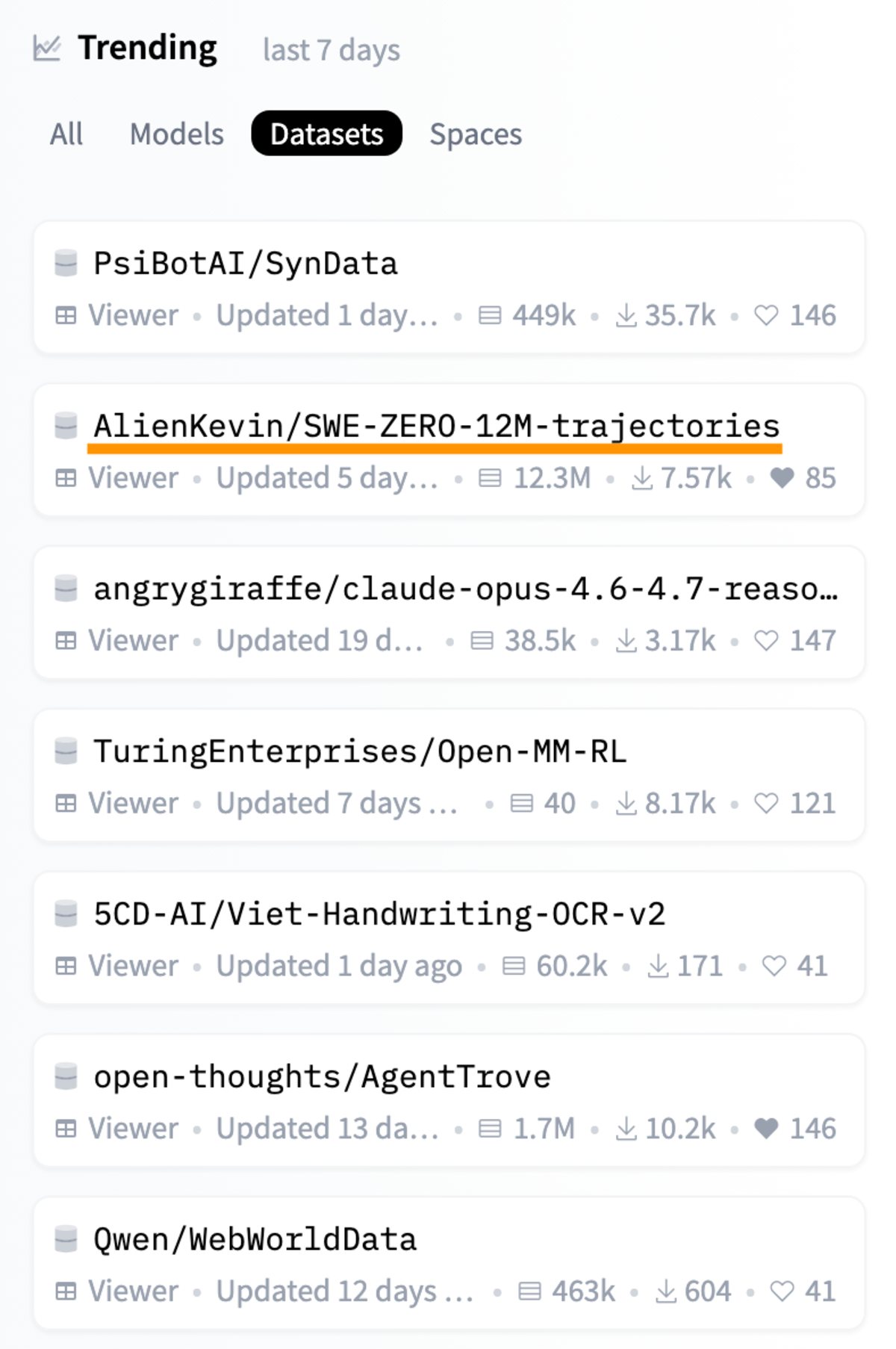
Trended #2 on Hugging Face datasets on May 19, 2026
Real-world agentic data is the bottleneck for training open coding models from scratch. Most public agentic datasets are post-training mixes: small SFT corpora distilled from frontier models that have already seen agent data. To grow capabilities through mid-training, you need orders of magnitude more.
The bottleneck is not GitHub. It is execution. The standard pipeline (e.g. SWE-smith) builds a Docker image per repo, installs dependencies, and runs the test suite as a verifier. This works beautifully for some repos but intricate or legacy configurations prevent many repos from building reliably within modern containerized environments, discarding everything else: repos with proprietary toolchains, broken build configs, or non-Python ecosystems. As Kimi-Dev put it: "while repository snapshots from GitHub are available, not all snapshots are equipped with an executable Docker environment."
SWE-ZERO-12M takes a different bet: skip execution entirely. The model is restricted to
standard POSIX commands (grep, find, cat, sed,
ls, git) and produces patches without ever compiling or running tests. This
unlocks the long tail of real-world software (122 K PRs across 3 K repos in 16 languages) and
sidesteps the per-task containerization overhead that makes verified pipelines expensive to scale.
| Dataset | Release | Rollouts | Total Tokens |
|---|---|---|---|
ricdomolm/mini-coder-trajs-400k |
2025-09-30 | 396,515 | 5.26 B |
nvidia/Nemotron-Terminal-Corpus |
2026-02-19 | 366,154 | 6.23 B |
nvidia/SWE-Zero-openhands-trajectories |
2026-04-17 | 318,115 | 8.92 B |
open-thoughts/AgentTrove |
2026-04-27 | 1,696,847 | 19.41 B |
AlienKevin/SWE-ZERO-12M-trajectories |
2026-05-12 | 12,290,800 | 111.06 B |
Source PRs come from nebius/SWE-rebench-V2-PRs.
For each PR, the pipeline samples 100 independent rollouts using
ricdomolm/mini-coder-1.7b, a 1.7 B
parameter model that hits an impressive 50.4 pass@100 on SWE-bench Verified, making it a
perfect fit for data generation at scale. The harness is
mini-SWE-agent v1, the minimalist agent loop
from the SWE-bench/SWE-agent team.
| Setting | Value |
|---|---|
| Rollouts per PR | 100 |
| Max turns per rollout | 15 |
| Sampling temperature | 1.0 |
| vLLM max model length | 32,768 tokens |
| vLLM max concurrent sequences | 256 |
Compute was sponsored by the TPU Research Cloud.
A first sanity check is diversity. MinHash-64 mean Jaccard similarity across the corpus comes out to 0.27, well under the 0.5 threshold used by Code World Model as a proxy for a diverse training set.
That tells us the rollouts are not collapsing onto a few repeated patterns, but it does not tell us whether training on them actually helps. For that, I trained Marin-8B on increasing subsets and evaluated on SWE-bench Verified:
| Training subset | Tokens | SWE-bench Verified pass@1 |
|---|---|---|
| Base Marin-8B | n/a | 0.0% |
| 10,000 rollouts | ~100 M | 3.3% ± 0.6 |
| 50,000 rollouts | ~570 M | 4.0% ± 2.0 |
| 100,000 rollouts | ~1.1 B | 5.3% ± 1.5 |
The trend is monotonic with scale, and these subsets use less than 1% of the full corpus.
A separate training run on Qwen3-1.7B-Base confirms the trend at the smaller scale. Across 10K → 100K → 1M SWE-ZERO traces, SWE-bench Verified pass@1 climbs from 7% → 9% → 11%, despite the 3.4% training submission rate:
| Training subset | Tokens | SWE-bench Verified pass@1 |
|---|---|---|
| 10,000 | ~75 M | 7/100 = 7% |
| 100,000 | ~754 M | 9/100 = 9% |
| 1,000,000 | ~7.5 B | 11/100 = 11% |
The dataset trended #2 on Hugging Face and drew responses from the agentic-eval community:
SWE-ZERO-12M is a mid-training corpus, not an SFT dataset. A few things to keep in mind:
incomplete rather than reaching
Submitted.Prior work suggests these limitations are forgiving for mid-training. NemotronTerminal's ablations show unfiltered data (12.4%) outperforms complete-only (6.74%) and success-only (5.06%) on downstream SWE-bench Verified. Useful learning signal lives in the incomplete trajectories too.
Yes, for end-to-end task completion. The median turn count to resolve a SWE-smith task with Qwen3 Coder
30B A3B is around 30, and at the 15-turn cap only ~3.4% of SWE-ZERO rollouts reach the
Submitted exit status. The cap is a deliberate trade. SWE-ZERO is a mid-training
corpus, not an SFT dataset. The goal is to instill agentic priors: how to issue bash commands, parse their
output, and navigate a repository. End-to-end task solving is left to a downstream SFT/RL stage on
higher-quality execution-verified data.
The empirical case for the 15-turn config:
There is almost certainly a sweet spot for max training length given a (teacher model, student model, task space, eval length) tuple. Pinning it down is open work and a direction I'd love to see more ablations on.
Per-trace, AgentTrove is higher quality since patches are verified against tests. SWE-ZERO trades that per-trace quality for reach: 12 M rollouts across 3 K repos and 16 languages, because it doesn't need a working Docker image per task.
A clean head-to-head between the two is harder than it looks: different agent harnesses, teacher models, and task instances all confound the comparison. The more useful framing is execution-free for mid-training, execution-based for SFT: lay down agentic priors with SWE-ZERO, then SFT on AgentTrove (or similar) to teach test-driven task completion. This mirrors the SWE-ZERO → SWE-HERO progression from the original SWE-ZERO paper.
My hypothesis is that they are complementary, not competing. Large-scale execution-free traces (this dataset, ~100 B tokens) pair naturally with smaller, higher-quality execution-based traces (200 B-token pytest stack-trace corpora, AgentTrove, etc.). Both should scale. Finding the right mixture and the right stage to consume each (pre-training vs. mid-training vs. SFT) is an open research question I'm excited about.